Living Room Lighting: Scenarios for Movies, Guests and Reading
Living room lighting: scenarios for movie nights, guests and reading
The living room is the one room in a home that plays a different part every evening: a cinema, a space for guests, a quiet corner for a book. A single ceiling point can't keep up with any of them — it either glares into the screen or leaves the sofa in the dark. Living room lighting works once the room has several independent sources drawn from the floor lamp and wall sconce collections at MAIIMO, each switched on for a specific moment rather than one fixture doing every job at once.
Three layers of light: why one point can't hold a room
The rule is simple: ceiling, wall and floor sit at three different heights, and each does its own job. The ceiling fixture sets the room's general tone and earns its keep when you're cleaning or hosting at full brightness. A wall sconce sits at roughly eye level and shapes the room's soft outline in the evening. A floor or table lamp brings light down to sofa height — at that point it stops being general lighting and becomes a personal zone. When all three layers exist separately in a room, every scenario switches on as one combination instead of a compromise. The most common mistake is buying one beautiful chandelier and stopping there: even the best ceiling light can't replace light at eye level or sofa height, because people in a living room are sitting, not looking up.
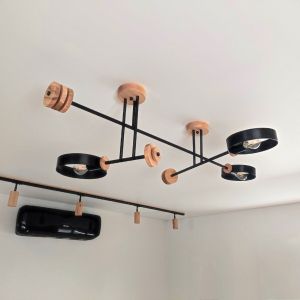
The ceiling layer doesn't have to be a plain disc centred on the room — it's actually the easiest place to show a room's character. Material matters here as much as shape: wood, metal, glass, papier-mâché and knitted fibre all read as completely different light even at the same brightness.
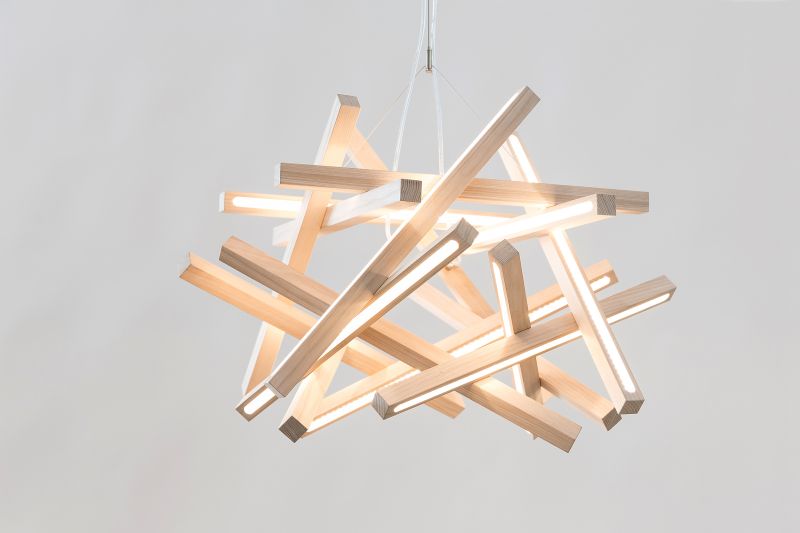
The fixture above ships with four LED colour options — 2700, 3000, 4000 and 5000 K — so the same ceiling layer can be tuned for a warm evening or bright daytime cleaning.
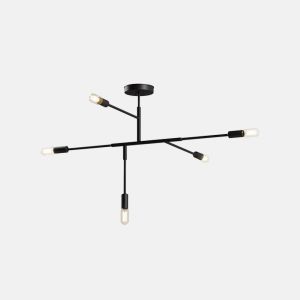
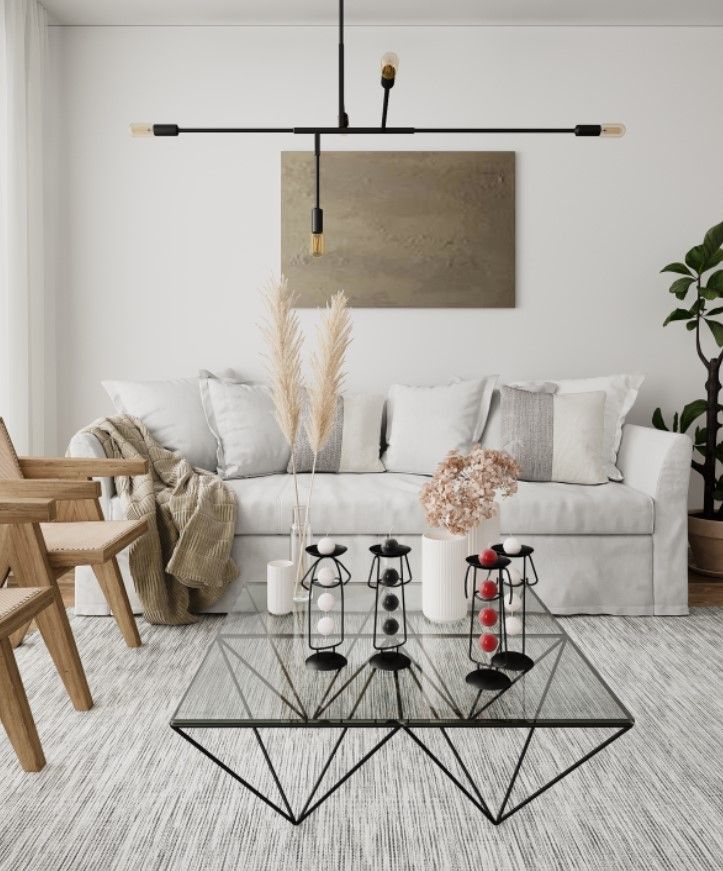
Metal reads completely differently: black steel on horizontal bars isn't a sculpture to admire so much as a structure that doesn't hide its own engineering. In the piece below, five bulbs on E27 sockets are spread across 111 cm, so light falls as a band above the sofa instead of one pool at the centre — a fit for a room after a harder, more industrial outline.
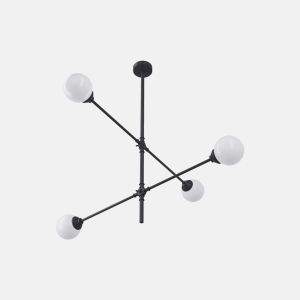
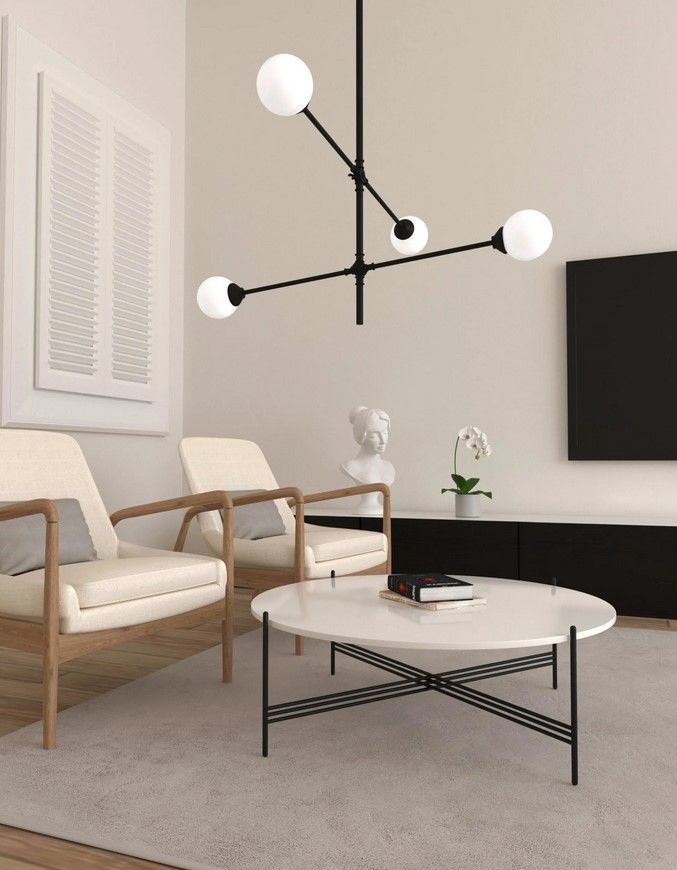
Brass and glass play off warm against cold: four globe shades on slim steel arms, each on its own G9 socket, leave air between them — the ceiling never turns into one solid mass, it breaks apart into separate points of light, like a small constellation above the armchairs or coffee table.
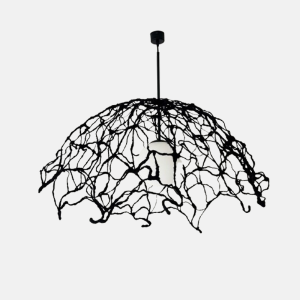
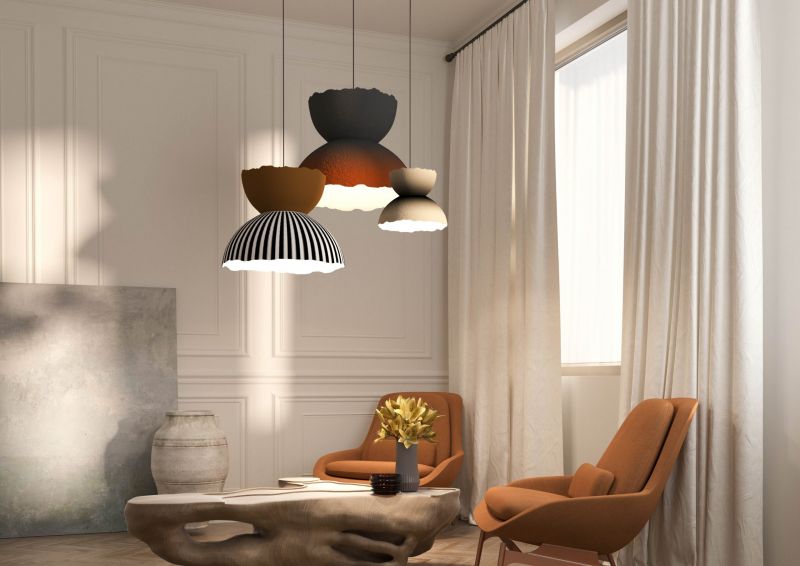
Papier-mâché behaves the opposite way to metal — it absorbs light rather than reflecting it. An uneven, torn-looking edge and a colour gradient make every fixture slightly different from the next, while the cellulose itself diffuses light softly, with no hard glare. Colour can be custom-ordered to match a room's palette, which makes this ceiling layer the easiest of the five to tune to a specific interior.
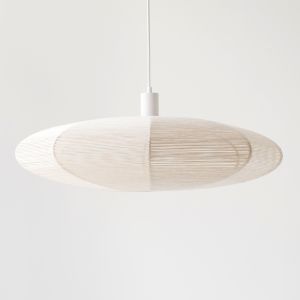
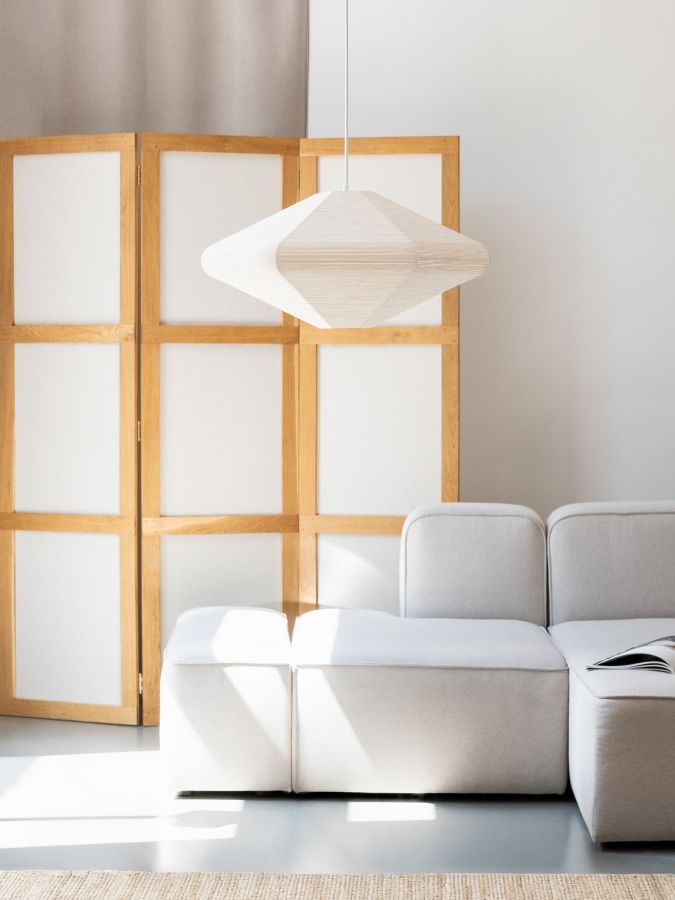
Knitted fibre is the softest of all five, quite literally: a metal frame wrapped in cord spun from recycled cotton, with not one hard surface or sharp edge anywhere on it. The milky-white or beige colour and the hand-knotted texture hold a room's boho character even switched off — it reads less like a light fixture and more like a textile piece that happens to glow.
All five follow the same logic — the ceiling sets the tone — they just set a different one: cool industrial steel, warm brass and glass, soft cellulose, or knitted fibre. See the full range in the chandelier collection at MAIIMO.
Movie night: warm side light instead of overhead
Before a film starts, overhead light goes off entirely — nothing should reflect in the screen. But total darkness tires the eyes more than the screen itself: what's needed is warm side light, kept well out of your sightline to the TV. An acoustic panel shaped as a floor lamp solves this in a single object: a warm 2700 K glow lights the room from the side, while the 9 mm-thick panel itself also absorbs echo in a room with hard flooring and a large screen.

Guests: a wall accent instead of one more lamp
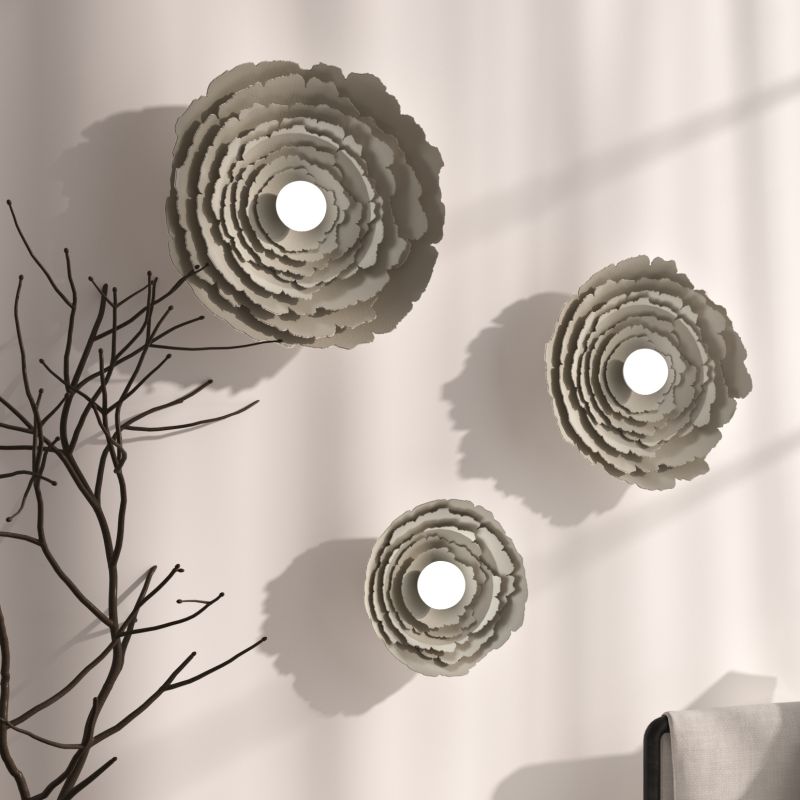
When people come over in the evening, the room needs more light than a quiet night in, but not the flat brightness of an office ceiling. A cluster of wall lights on a single wall reads as an occasion the moment it's switched on: three matching shapes in different sizes, spaced unevenly, hold the eye and add volume of light without a single extra cord on the floor or side table. Warm colour temperature matters more than brightness here — it's what separates a night with guests from a meeting room, even when there's objectively more light in play.
A private island of light for reading
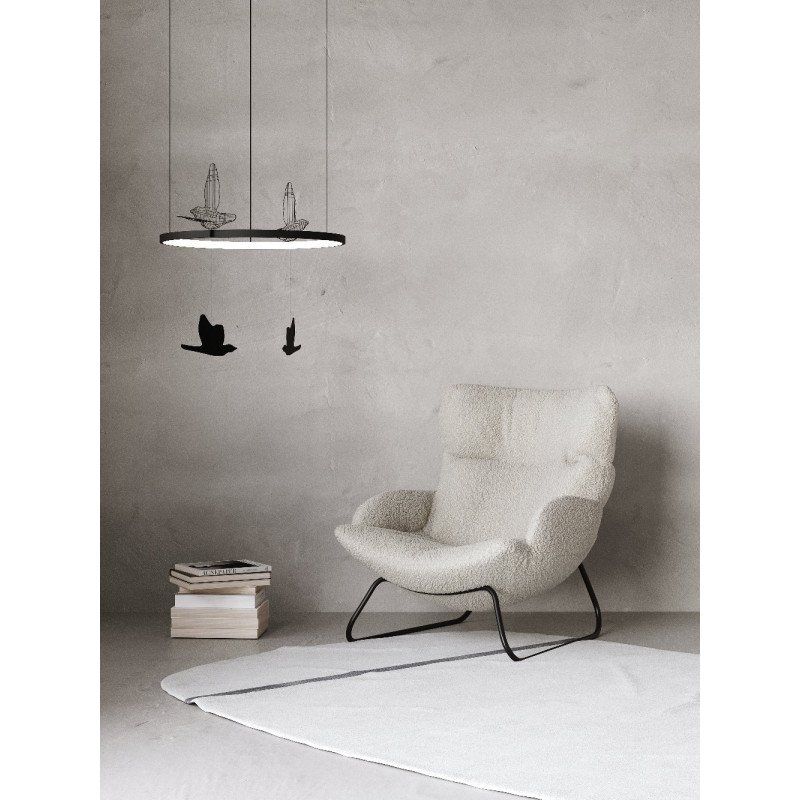
Reading doesn't need light across the whole room — one point beside an armchair or the end of a sofa is enough, and it shouldn't interfere with the other scenarios. And it doesn't have to come from the floor: the same ceiling layer turns personal the moment it's hung directly above a chair instead of centred in the room. A circular fixture on thin cables drops to the right height independently of the main light and leaves the rest of the corner in half-shadow.
A middle layer with no extra cord
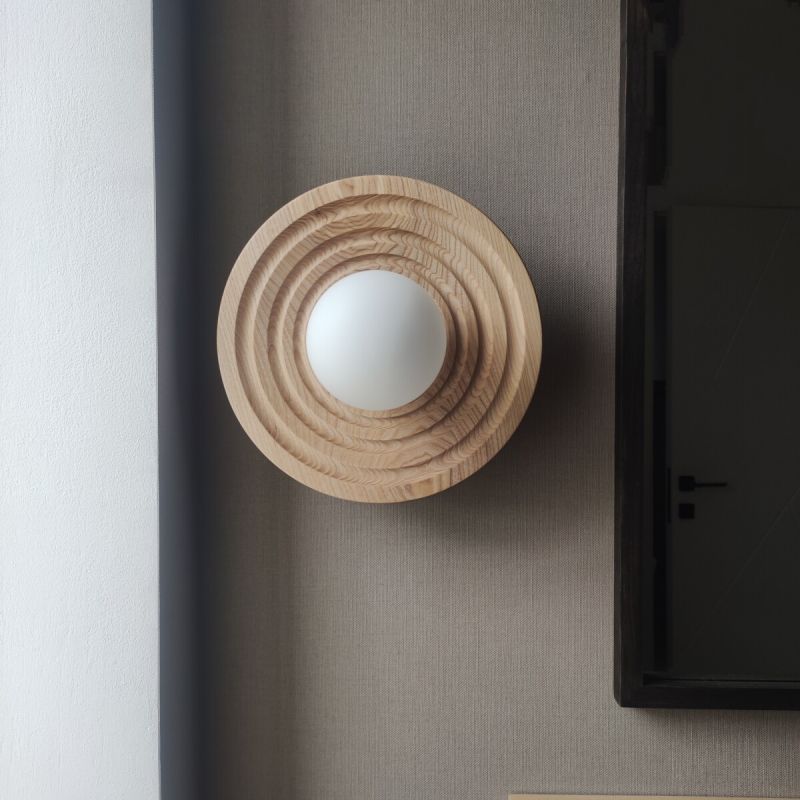
The wall level is convenient precisely because it takes up no floor space and doesn't depend on an outlet near the sofa. A glass shade on an ash-wood base, lit from within so the wood's grain glows through in rings, works as a standalone object even switched off during the day — and in the evening it adds exactly the middle layer of light that holds a room's outline between a bright ceiling and a dark floor.
Dimmers and scenes: one button, a different mood
The three layers only pay off fully with a dimmer or smart switch on each one independently. The "movie" scene: ceiling off, side floor lamp at 30%. The "guests" scene: ceiling and wall cluster together, floor lamp off. The "reading" scene: only the corner light, the rest of the room at rest. Set once, these three combinations switch with a single touch instead of three separate switches every evening.
A short starting guide
Start with the ceiling fixture as your base — it's the one that sets the room's general tone during the day. Add a wall layer wherever you plan to host guests or hang a mirror or artwork. Place floor or table light separately for each personal zone — an armchair, a reading corner, the sofa facing the screen. Then check the result: if every layer can switch off independently of the others, your living room lighting is genuinely built from scenarios, not from one lamp centred on the ceiling.
FAQ
How many light sources does a living room need? At least three independent ones: ceiling, wall, and floor or table. Each switches on separately for its own scenario.
What if there's no outlet near the sofa for a floor lamp? Move the accent layer to the wall — a sconce doesn't depend on where floor outlets sit and gives the same in-between level of light.
Does every fixture need a dimmer? At minimum, put one on the ceiling fixture and the floor lamp — those two create the contrast between a movie-night scene and an ordinary evening.
Where do I start if my living room only has a ceiling chandelier right now? Add one wall light where guests usually sit, plus one floor or table light in the relaxing zone. Those two extra layers are already enough to stop the room depending on a single fixture.