How to Size Wall Art Above a Sofa, Bed or Console
- How to Size Wall Art Above a Sofa, Bed or Console
- Measure the furniture, not the wall alone
- Choosing artwork size above a sofa
- Art above a bed: safety before symmetry
- Art above a console table
- Shape changes how size feels
- Painter’s tape: the most honest way to test scale
- Quick answers
- How high should artwork be hung?
- How do you calculate artwork size above a sofa?
- How much space should there be between pictures?
- Should artwork be narrower than a console?
How to Size Wall Art Above a Sofa, Bed or Console
Artwork that is too small can make a large wall feel even emptier. Go too large and it may crowd the furniture and take the air out of the room. That is why the right size artwork above a sofa should be judged against the furniture it belongs with, not the amount of blank wall available.
The familiar two-thirds rule is useful only as a starting point. Real centimetres, backrest height, the shape of a headboard, lamps on a console and viewing distance all affect the result. The method below turns those variables into a layout you can test with paper and painter’s tape.

Measure the furniture, not the wall alone
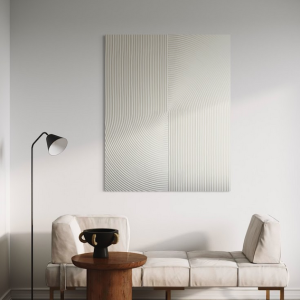
Begin with the width of the sofa, headboard or console. Then calculate the artwork’s total outside width: the frame for a single piece, or every element and gap for a diptych or gallery arrangement. A range of 55–75% of the furniture width usually makes a convincing first mock-up.
Why not one exact number? A dark canvas carries more visual weight than a pale one, a wide frame adds volume, and a circle leaves open wall at the corners. A floor lamp, wall light or tall vase may also sit nearby. They affect the balance even though a tape measure cannot add them to the equation.
| Placement | Starting artwork width | Gap above furniture | Remember to check |
|---|---|---|---|
| Above a sofa | 55–75% of sofa width | 15–25 cm above the back | Cushion height, floor lamps and seated eye level |
| Above a bed | 50–75% of headboard width | 20–30 cm above the headboard | Headboard height, wall lights and secure mounting |
| Above a console | 60–90% of console width | 15–25 cm above the top or display | Lamps, vases and objects that change the upper outline |
| On an empty wall | Follow the architecture of the wall | Centre at roughly 145–150 cm from the floor | Actual eye level and viewing distance |
These figures are not building regulations. They help you make a mock-up; your eyes make the final decision. A very low sofa or unusually tall headboard will change the spacing.
Choosing artwork size above a sofa
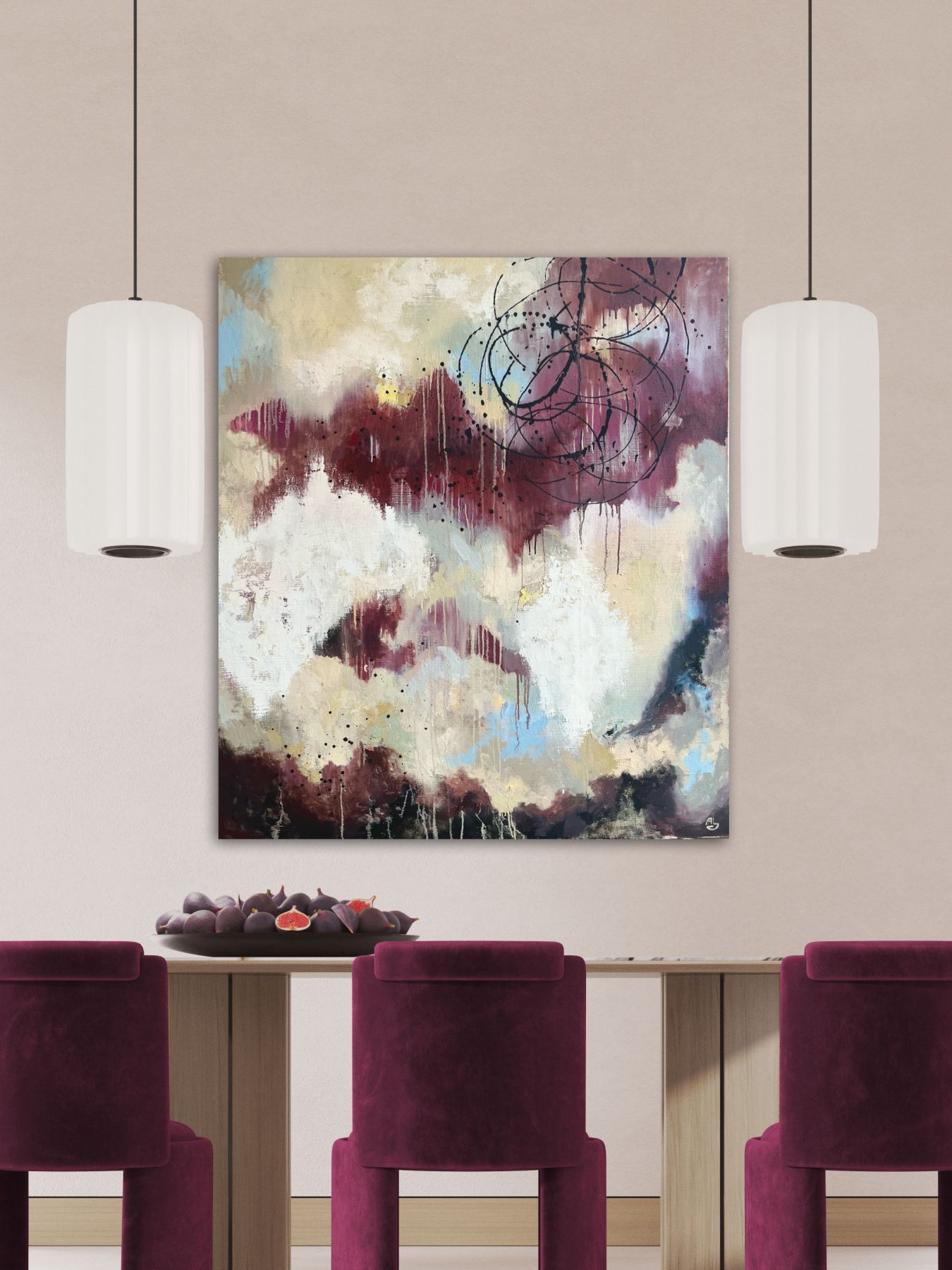
For a sofa 220 cm wide, begin with an arrangement around 120–165 cm wide. A calm horizontal canvas can sit near the upper end of that range. A narrow vertical piece often needs a companion beside it, otherwise the wide seat and slim artwork can feel disconnected.
With a sectional, do not centre the art across the full length of every module. Use the main seating area or the visible stretch of wall as your reference. In a generous living room, try the scale of large-format paintings: one confident work often feels calmer than a collection of small frames chosen simply to fill space.
Art above a bed: safety before symmetry
Artwork above a bed is usually scaled to the headboard rather than the mattress. For a 180 cm headboard, a useful starting range is approximately 90–135 cm. If there are wall lights on both sides, leave room for them and check that their pools of light do not clash with the frame.
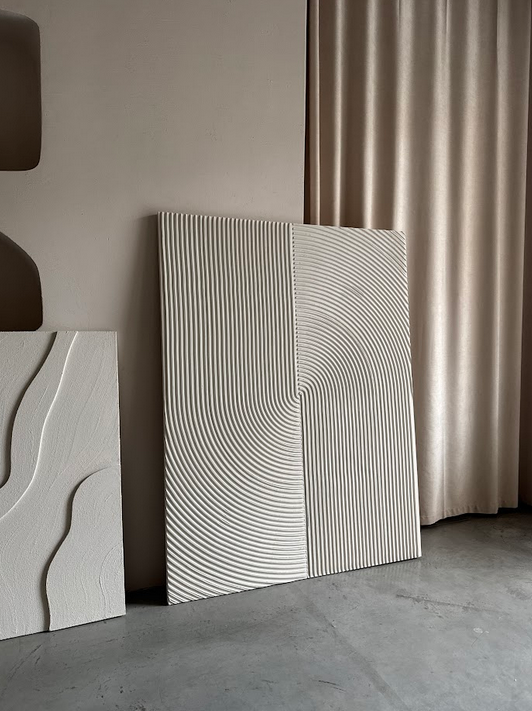
Heavy wall panels need fixings chosen for the wall construction and the object’s actual weight. A single improvised hook above a headboard is not enough. When in doubt, move a substantial three-dimensional work to an adjacent wall or ask a professional installer.
Art above a console table
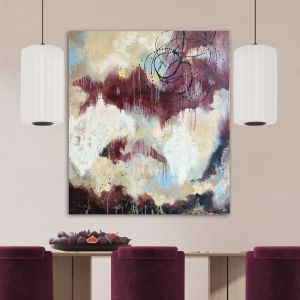
A console allows more freedom because both the furniture and the objects on top shape the composition. The artwork might occupy 60–90% of its width, but a tall lamp or branch in a vase already adds height. In that case, shift the picture away from the geometric centre and build an asymmetrical balance.
Avoid identical gaps between every object. Let part of the display overlap the picture’s visual field while the other side stays more open. The console will feel composed rather than arranged like a row of exhibits.
Shape changes how size feels
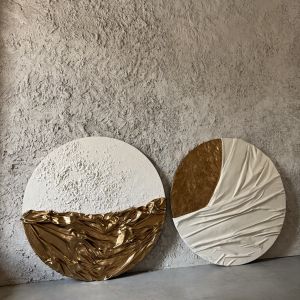
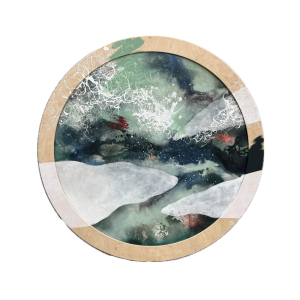
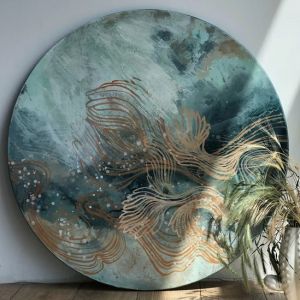
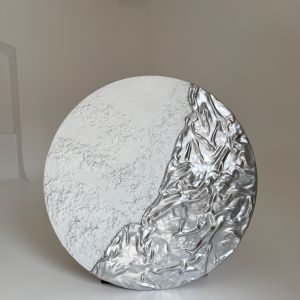
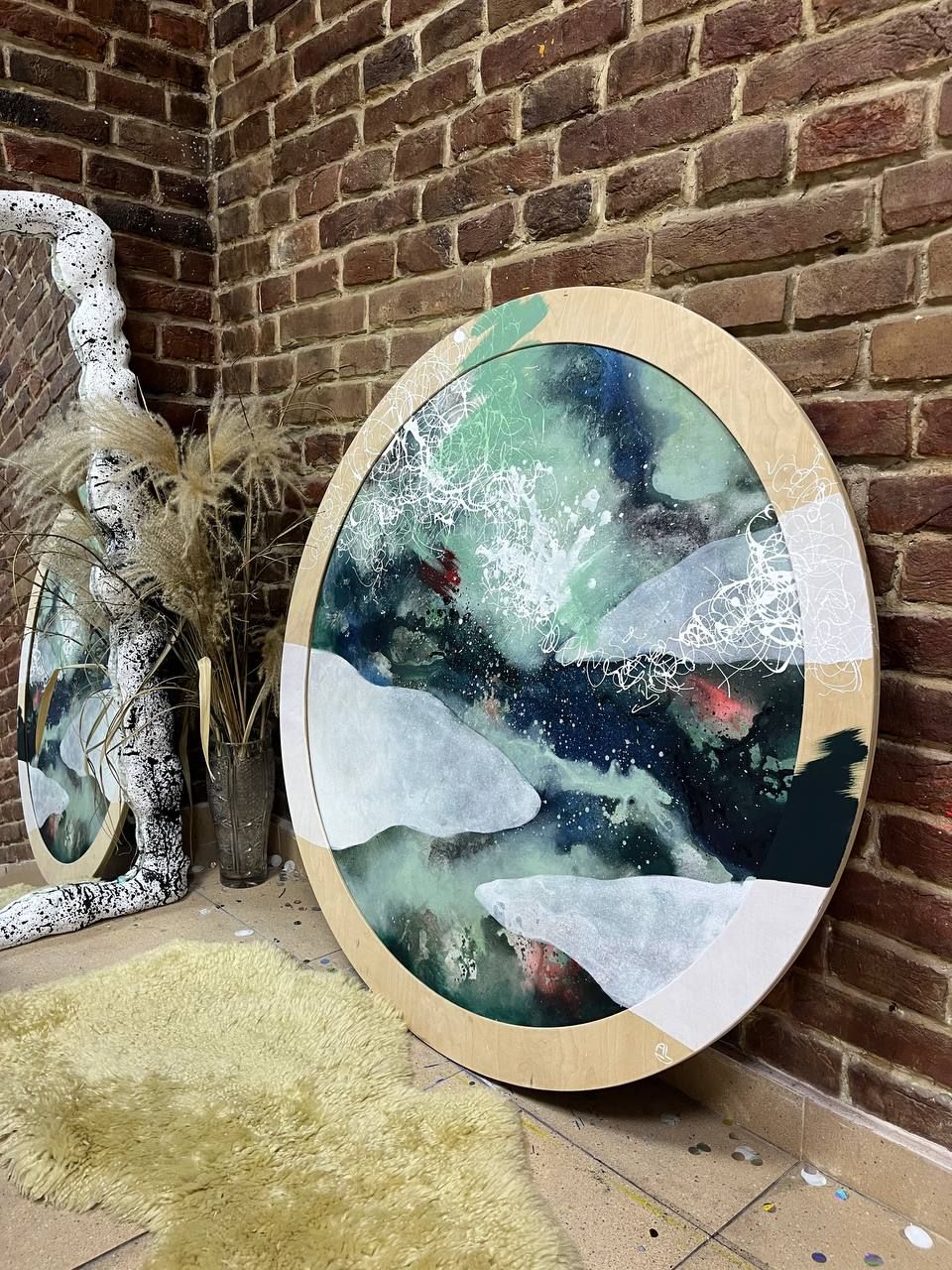
A rectangle fills almost all of its outside boundary. A circle leaves the corners open, so it feels lighter at the same overall width. That is why paintings on round canvases can often be sized a little more boldly, especially over a compact sofa or a console with softened edges.
Relief adds visual weight too. Textured paintings cast shadows and change in side light, so a paper template reveals only their dimensions. Before deciding, ask for a side view or a video filmed in different lighting.
Painter’s tape: the most honest way to test scale
- Mark the centre line of the furniture on the wall.
- Tape out the full-size outline of the artwork or complete group.
- For a diptych, include the exact gap between the panels.
- Check the layout while standing, sitting and entering the room.
- Leave it up until evening: artificial light changes how scale is perceived.
If you are deciding between two sizes, tape both outlines in different colours. The larger option often looks more resolved, but not always. A narrow section of wall, a visually assertive frame or a nearby cabinet may make the smaller work more precise. Proportion is not a formula for beauty. It is a way to see the relationship between art and room before buying.
Quick answers
How high should artwork be hung?
On an empty wall, begin with the centre of the artwork roughly 145–150 cm above the floor. Above furniture, the relationship matters more: the lower edge often sits 15–25 cm above a sofa or console.
How do you calculate artwork size above a sofa?
Multiply the sofa width by 0.55 and 0.75 to create a useful starting range. For a 220 cm sofa, that is about 120–165 cm. Then test the full outline on the wall.
How much space should there be between pictures?
For a small group, gaps of 5–10 cm often work well. Keep them consistent and smaller than the margins around the complete composition. Large canvases may need a wider pause.
Should artwork be narrower than a console?
Usually, yes. A piece that is 60–90% of the console width is easy to connect visually with the furniture. Art can extend beyond its edges as a deliberate move, but then open wall, lighting and restrained styling need to restore the balance.